

Affiliate disclosure: This post may contain affiliate links. I may earn a commission from qualifying purchases made through these links, at no additional cost to you. As an Amazon Associate I earn from qualifying purchases.
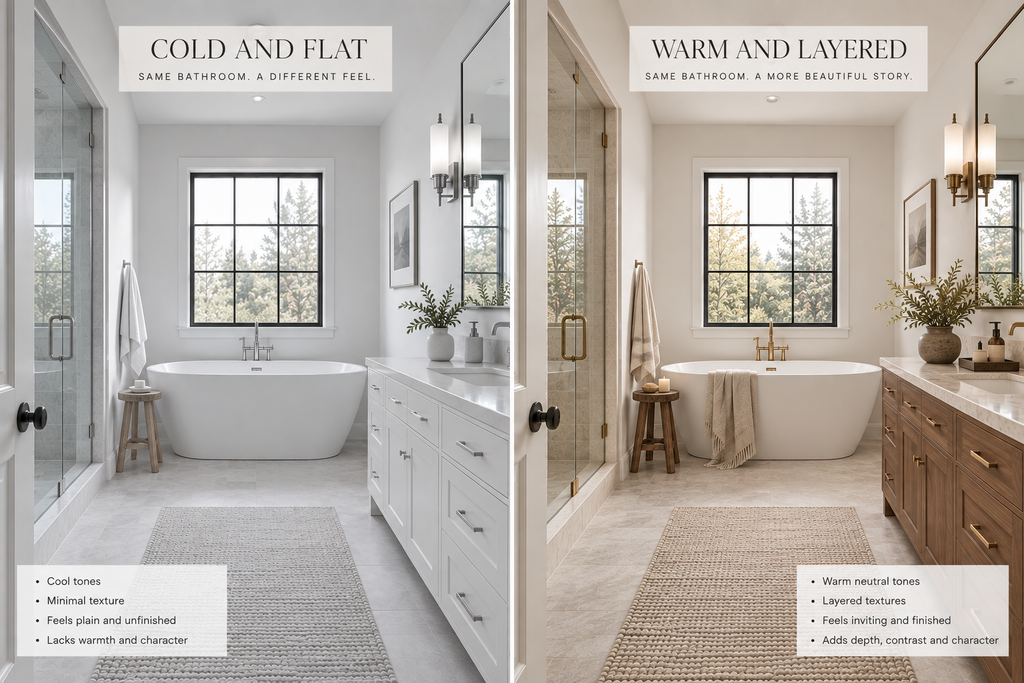
A neutral bathroom can have all the “right” colors and still feel cold, flat or builder-basic.
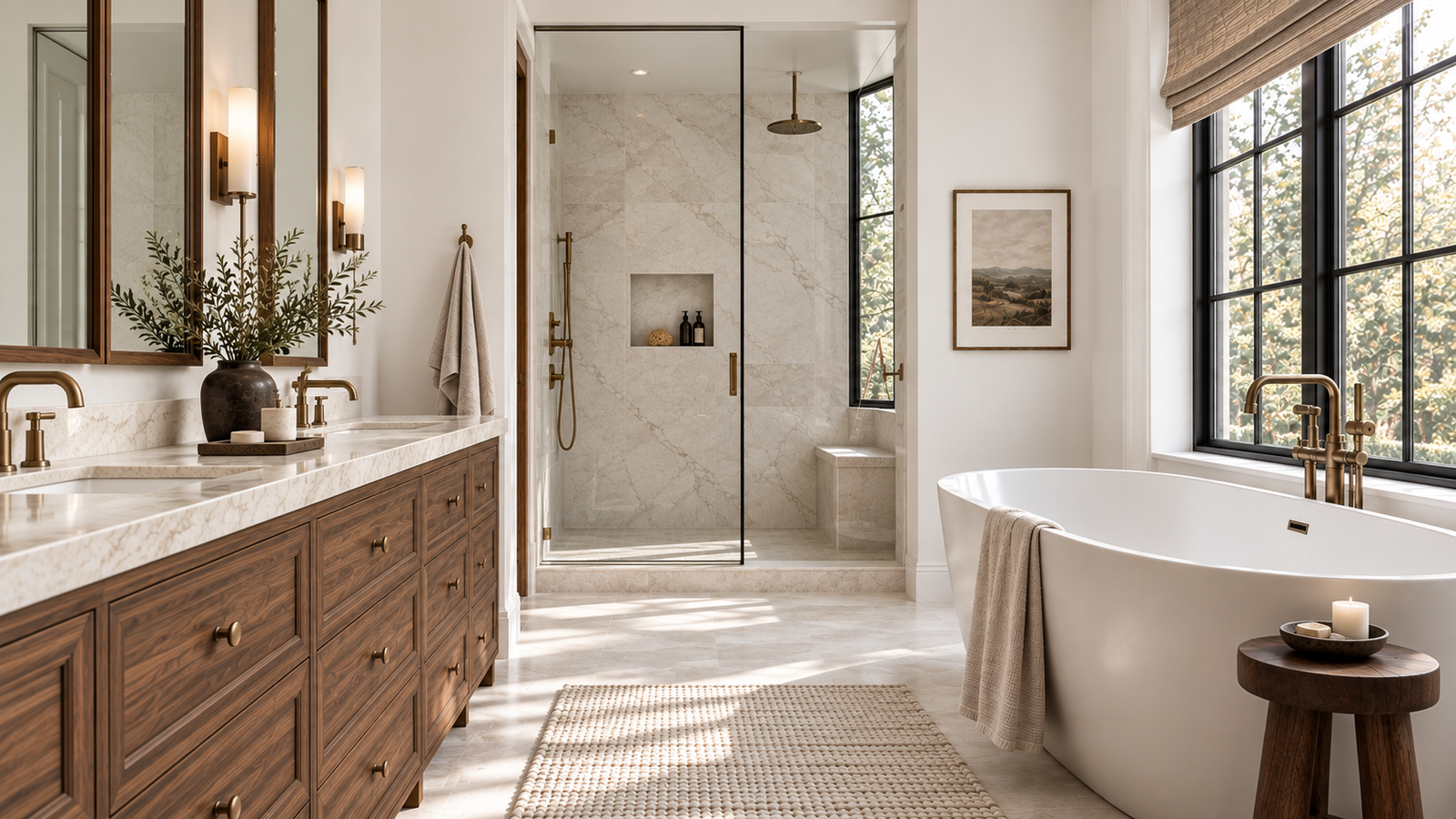
If you’re trying to figure out how to make a neutral bathroom feel warm, don’t start by adding more beige. First look at the bigger layers of the room: lighting, fixed finishes, wood, contrast, texture and scale.
Once you know what is making the room feel unfinished, it becomes much easier to decide what to keep, what to change and what is actually worth buying.
How to Make a Neutral Bathroom Feel Warm: The Formula
A neutral color palette does not automatically create warmth.
Bathrooms contain a lot of naturally hard surfaces: tile, glass, porcelain, mirrors, stone and metal. When most of those surfaces are pale, smooth or cool-toned, the room can feel sterile even when everything technically “matches.”
Before buying anything, diagnose the problem.
The Neutral Bathroom Diagnostic
| If your bathroom feels… | Look at this first | What may be missing |
|---|---|---|
| Cold | Lighting and undertones | Warmer light, wood or balanced warm tones |
| Flat | Texture and tonal variation | Linen, woven texture, stone, wood grain |
| Too beige | Contrast | Walnut, chocolate, bronze, olive or deeper taupe |
| Builder-basic | Mirror, lighting and scale | One or two stronger finishing choices |
| Cluttered | Countertops and open storage | Editing and consolidation |
| Unfinished | Textiles and functional decor | Bath mat, towels, curtain, storage or art |
The important part is not to fix every category at once.
If the bathroom feels cold because of harsh lighting, replacing the soap dispenser will not solve it. If everything is the same shade of beige, adding another tan basket probably will not solve that either.
Fix the strongest problem first.
Start With What You Can’t Change
If you are not remodeling, the bathroom should be designed around the finishes that are staying.
Identify Your Fixed Finishes
Start with the largest permanent surfaces:
- Floor tile
- Shower or tub surround
- Wall tile
- Countertop
- Vanity
- Tub and plumbing fixtures
These surfaces determine which new colors and materials will feel connected to the room.
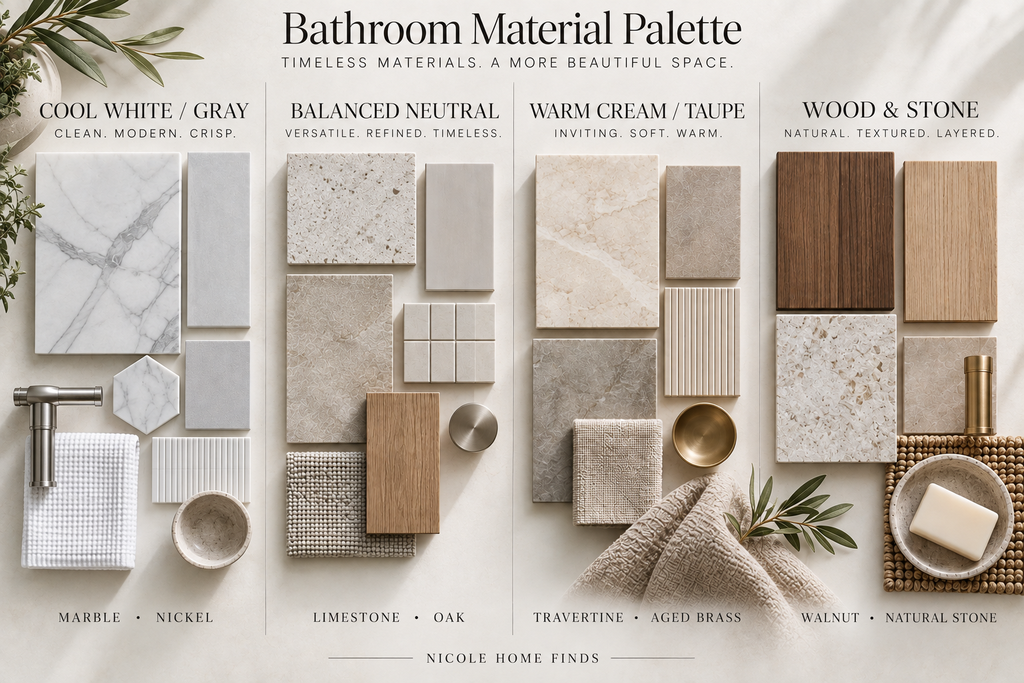
For example, if you have cool gray tile that you cannot replace, very yellow beige can make the gray look even cooler by comparison. A softer mushroom, balanced taupe, warm white or medium wood tone may bridge the existing gray more naturally.
Check the Undertones
You do not need to identify the exact undertone of every surface. Look at them together and ask:
- Does the white look crisp or creamy?
- Does the gray lean blue, green or warmer taupe?
- Does the beige lean yellow, pink or brown?
- Does the countertop look cool gray, cream, brown or balanced?
- Is the vanity wood warm, red, gray or neutral?
The goal is coordination, not perfect matching.
A bathroom often looks more collected when the materials are related without being identical.
The Warm Neutral Bathroom Formula
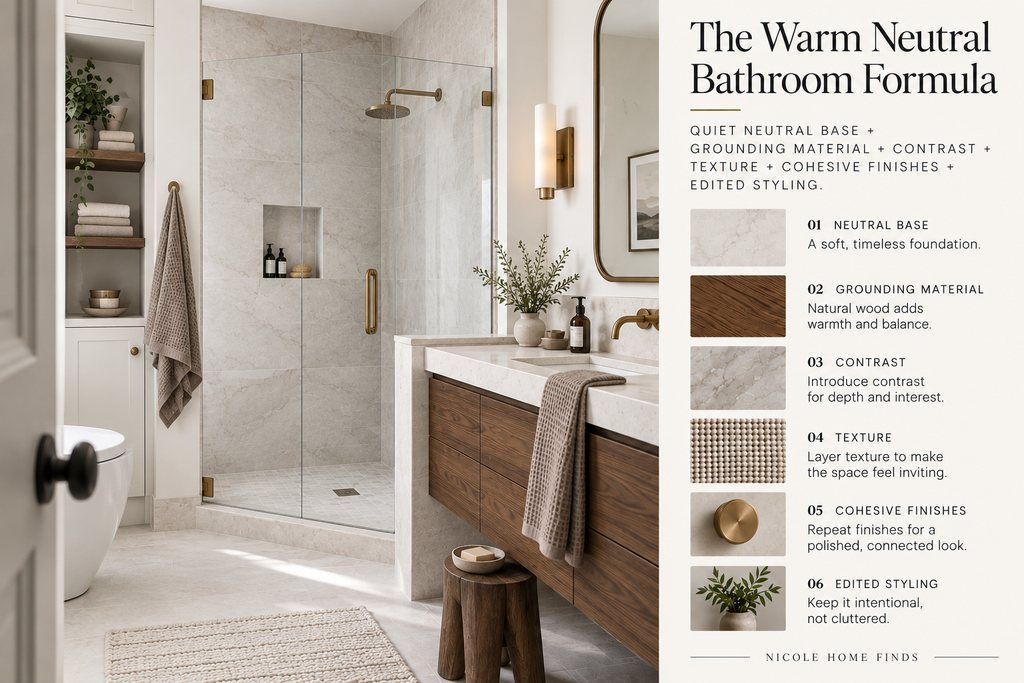
The strongest warm neutral bathroom ideas are layered rather than monochromatic.
A useful formula is:
1. Start With a Quiet Base
Use the bathroom’s existing finishes to guide the base.
Depending on the room, that might be:
- Warm white
- Cream
- Ivory
- Mushroom
- Taupe
- Soft greige
The base should support the fixed finishes rather than becoming the entire design.
2. Add One Grounding Element
Pale rooms usually need something with more visual weight.
Good options include:
- Walnut
- Medium oak
- Chocolate brown
- Bronze
- Muted olive
- Deeper mushroom or taupe
You do not need all of them.
One grounding element can be enough.
3. Layer Texture
Bathrooms need softness because so many of their permanent surfaces are smooth.
Try:
- Waffle cotton
- Linen or linen-look fabric
- Woven storage
- Wood grain
- Textured ceramics
- Matte or honed stone
- A substantial bath mat or runner
4. Create Contrast
Contrast keeps warm-neutral rooms from becoming a blur of similar beige.
It does not have to be black.
Cream against walnut, warm white against medium oak or ivory against muted olive can create enough definition while keeping the space soft.
5. Keep Finishes Intentional
The lighting, mirror and hardware do not have to match exactly.
They should, however, look as though they belong in the same room.
6. Finish With Restraint
The final layer should make the bathroom feel complete—not crowded.
A bath mat, good towels, a shower curtain, useful storage and one or two intentional accessories often do more than a collection of small decorative objects.
The Formula in One Line
Quiet neutral base + grounding material + contrast + texture + cohesive finishes + edited styling.
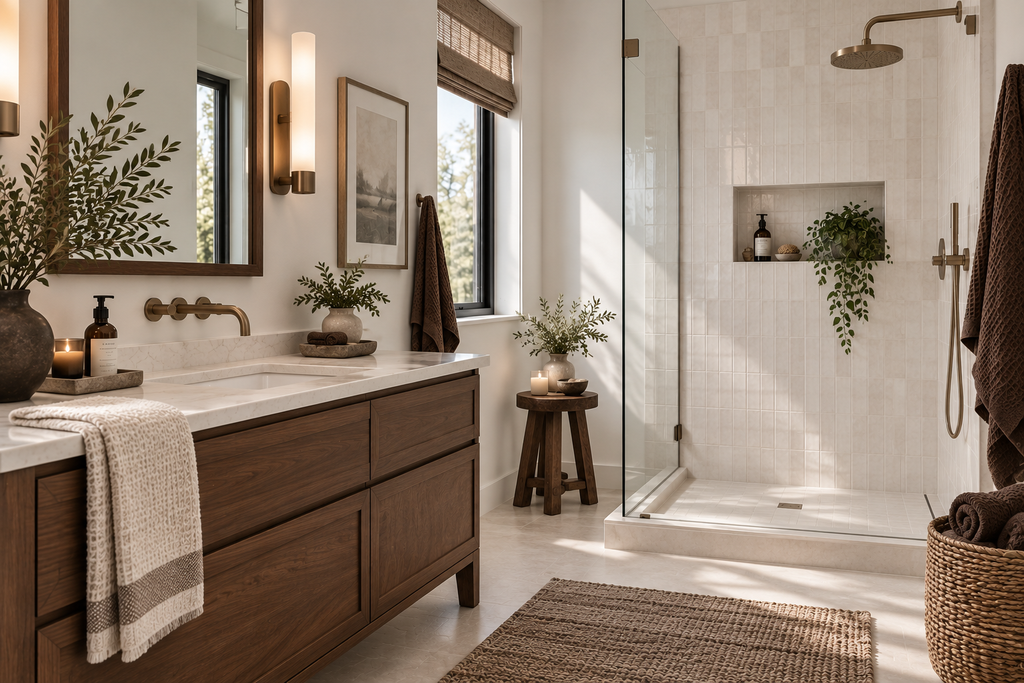
Add Warmth With Wood, Contrast and Texture
If the bathroom is structurally fine but still feels sterile, these three layers can make the biggest visual difference.
Use Wood Based on How Much Contrast the Room Needs
Wood softens a bathroom because it interrupts all the glass, tile, porcelain and metal.
Oak keeps a room lighter. It works especially well with warm white, cream, limestone and soft taupe.
Walnut creates more grounding and contrast. It can be especially useful when the bathroom contains a lot of pale tile or cabinetry.
A simple decision rule:
If the room already has enough contrast, use lighter wood. If everything looks washed together, try a deeper wood tone.
And you do not need to replace the vanity.
Wood can come from a:
- Framed mirror
- Small stool
- Shelf
- Tray
- Storage piece
- Decorative but useful box
If you use natural wood in a bathroom, make sure the specific product and finish are suitable for its intended location and exposure to moisture. Bathrooms need effective moisture control and ventilation, particularly around showers and other wet areas.
Stop Adding More Beige
One of the easiest ways to make a beige bathroom look flat is to keep adding more versions of the exact same color.
Instead, create a little tension.
Try combinations such as:
Cream + walnut + chocolate brown
Warm white + oak + mushroom
Ivory + walnut + muted olive
Cream + limestone + bronze
Warm white + taupe + medium brown
Notice that these palettes are still neutral.
They simply have enough variation to create depth.
Warm does not have to mean yellow, and neutral does not have to mean beige-on-beige.
Add Texture Before You Add More Decor
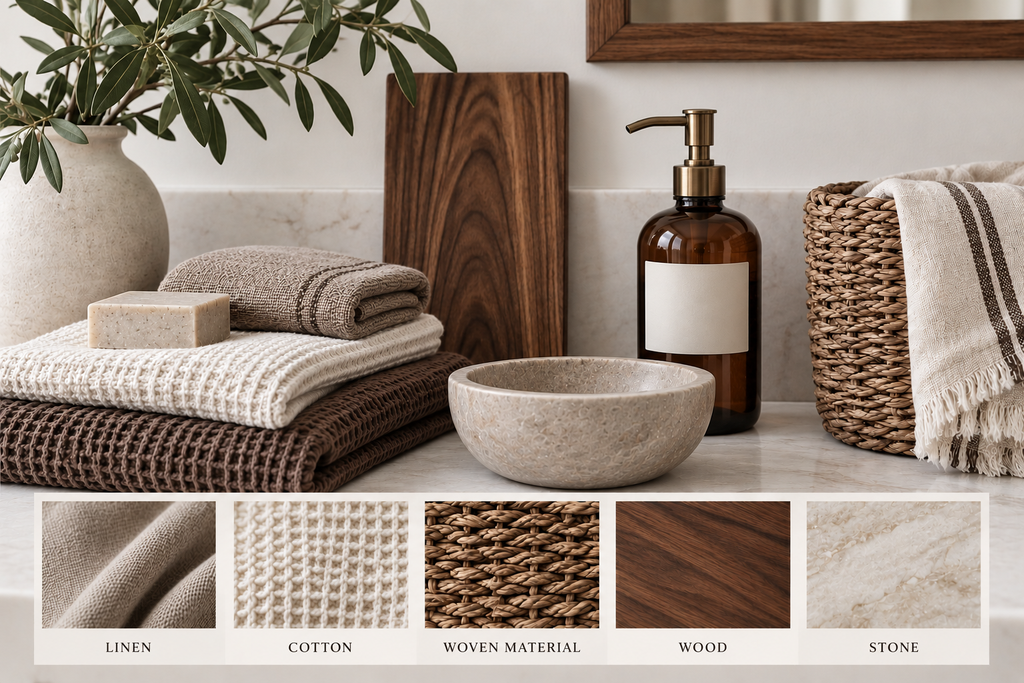
If a neutral bathroom feels boring, texture is often more useful than another color.
Try mixing two or three tactile materials rather than adding more decorative objects.
For example:
smooth stone + woven basket + waffle towel
or:
cream tile + walnut + linen-look shower curtain
or:
white vanity + textured runner + handmade-look ceramic
The room becomes more interesting because the surfaces respond differently to light.
Fix the Lighting Before You Change the Whole Palette
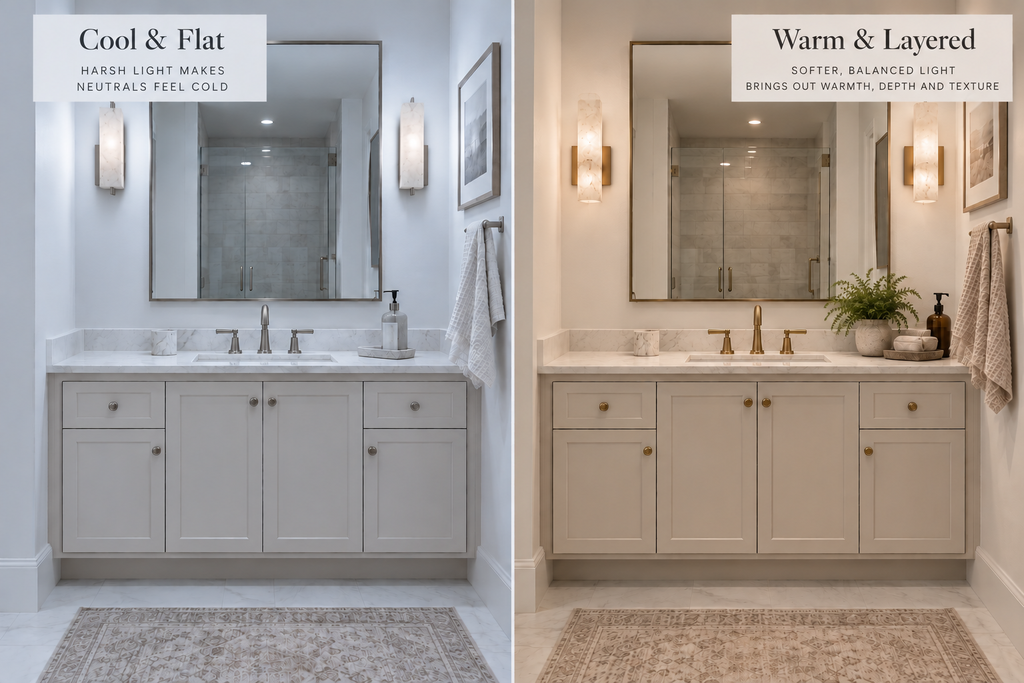
If your neutral bathroom looks beautiful in daylight but cold or gray at night, lighting may be the real problem.
Color temperature is measured in Kelvin. Lower color temperatures appear warmer, while higher temperatures appear cooler. For a warm-neutral bathroom, roughly 2700K–3000K is a useful range to consider, but color temperature should not be the only factor.
Vanity lighting also needs to be functional.
Pay attention to:
- Color rendering
- Fixture placement
- Shadows around the face
- Natural daylight
- The finish of surrounding materials
- Whether the room needs both ambient and task light
Avoid trying to make the bathroom feel warmer by choosing extremely yellow light. The goal is a flattering, comfortable white light that supports the materials in the room.
If your cream tile suddenly looks gray at night, test the lighting before changing the tile, paint or textiles.
You Don’t Need Brass to Make a Bathroom Feel Warm
Brass and bronze can reinforce a warm palette, but they are not required.
A bathroom with chrome faucets can still feel warm when the room also includes:
- Natural wood
- Cream or mushroom textiles
- Soft lighting
- Stone
- Woven texture
- Warm white walls
The same is true of polished nickel or even a limited amount of black.
If replacing every faucet and fixture would be expensive, keep the metal you already have and ask a better question:
Does the rest of the room have enough softness, texture and warmth to balance it?
That is usually more useful than assuming every warm bathroom needs brass.
How to Make a Neutral Bathroom Look More Expensive Without Remodeling
An expensive-looking bathroom does not require expensive everything.
What usually makes the difference is scale, consistency and editing.
If you want the room to feel more elevated without a full renovation, concentrate your budget on the things that are visually prominent.
Upgrade the Mirror
A mirror occupies a large amount of wall space, especially above the vanity.
Look for:
- A size that relates properly to the vanity
- A frame that works with the other finishes
- A shape that suits the room
- Simple, intentional proportions
If a small mirror is floating over a wide vanity, improving the scale can have more impact than adding several accessories.
Improve the Lighting
Lighting is both functional and highly visible.
If the existing fixture feels undersized, dated or disconnected from the rest of the room, this can be a more worthwhile upgrade than replacing smaller decorative pieces.
Upgrade the Textiles
Towels, bath mats, runners and shower curtains occupy enough visual space to influence the entire palette.
Use them to add:
- Texture
- Contrast
- Warmth
- A more substantial material presence
If the room is already beige, try mushroom, ivory, soft brown, warm white or muted olive instead of automatically choosing tan.
Simplify the Finish Palette
Mixed finishes can look intentional.
Random finishes rarely do.
You do not need every piece to match, but repeat enough visual cues that the combination looks deliberate.
For example:
chrome faucet + polished nickel mirror + restrained cool-metal hardware
or:
aged-brass light + brass-framed mirror + limited brass hardware
or:
black shower frame + warm wood + a few repeated black details
Reduce Countertop Clutter
Before buying new decor, remove what is making the room noisy.
Keep everyday products accessible, but consolidate smaller items into:
- Drawers
- Baskets
- A tray
- Closed storage
One appropriately scaled object generally has more visual impact than a lineup of tiny accessories.
Add One Strong Natural Material
If the room contains mostly manufactured hard surfaces, introduce one material with visible natural variation.
That might be:
- Wood
- Stone
- Linen
- Woven material
- Textured ceramic
You do not need all five.
One or two are enough to make the room feel less generic.
Shop the Finishing Pieces
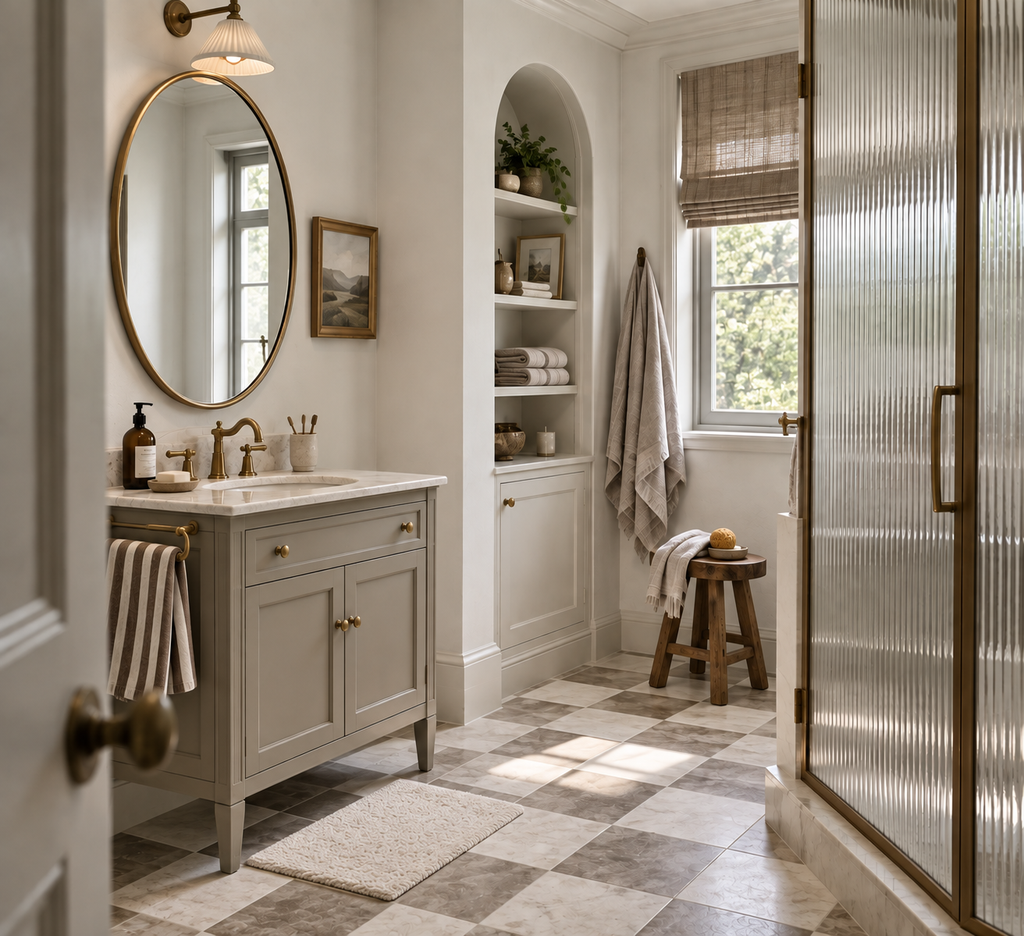
Simple upgrades that add warmth, texture and polish—without remodeling.
Walnut-Finish Arched Bathroom Mirror
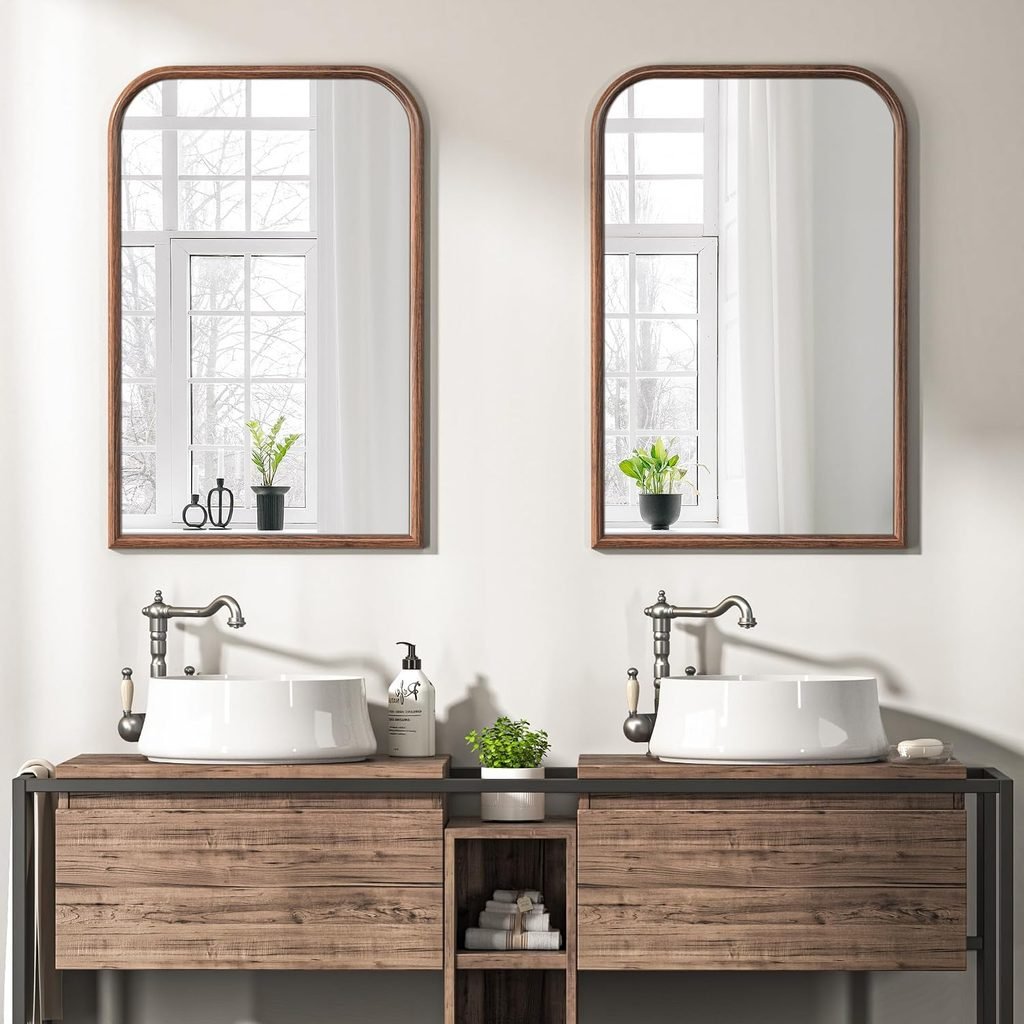
Adds warmth and character to a neutral bathroom.
Textured Cream Shower Curtain
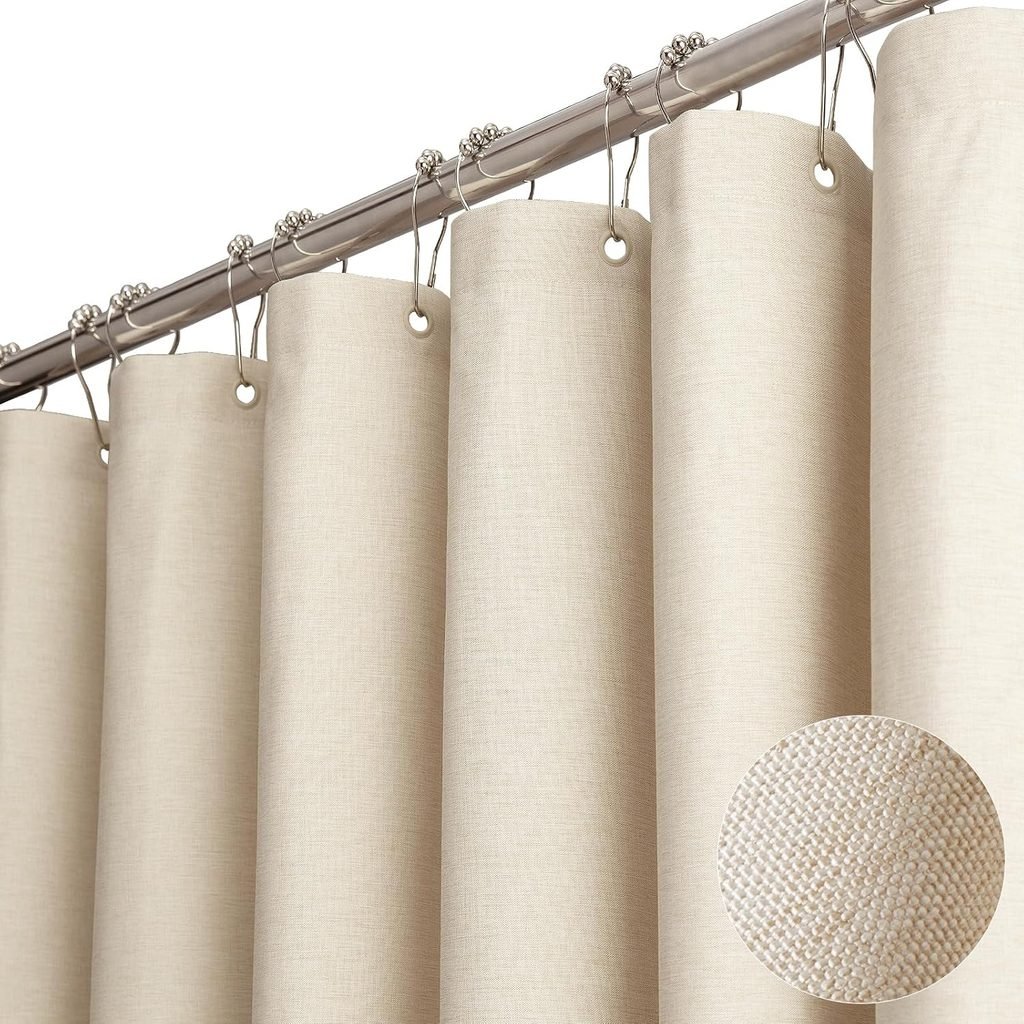
Adds soft texture while keeping the room light.
Textured Cream Bathroom Rug
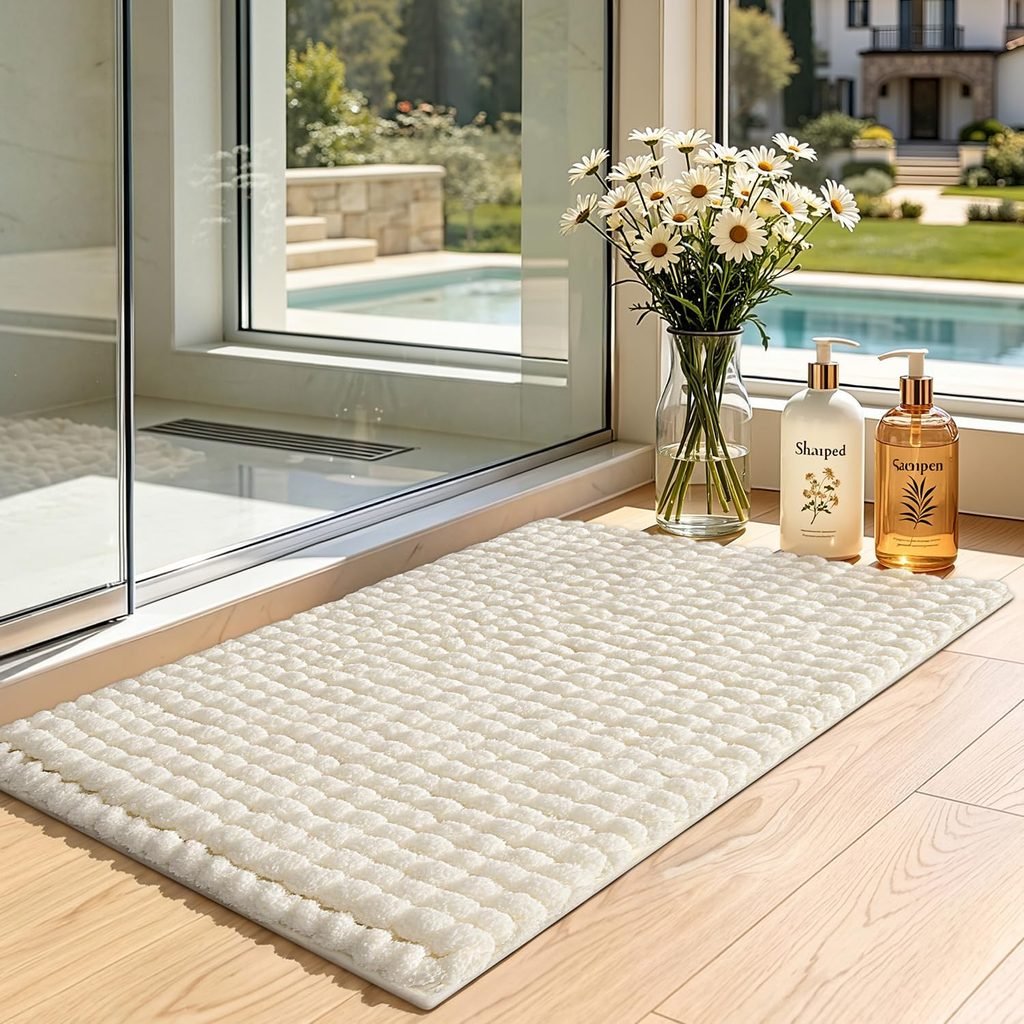
Adds plush texture and warmth underfoot.
Woven Bathroom Storage Baskets
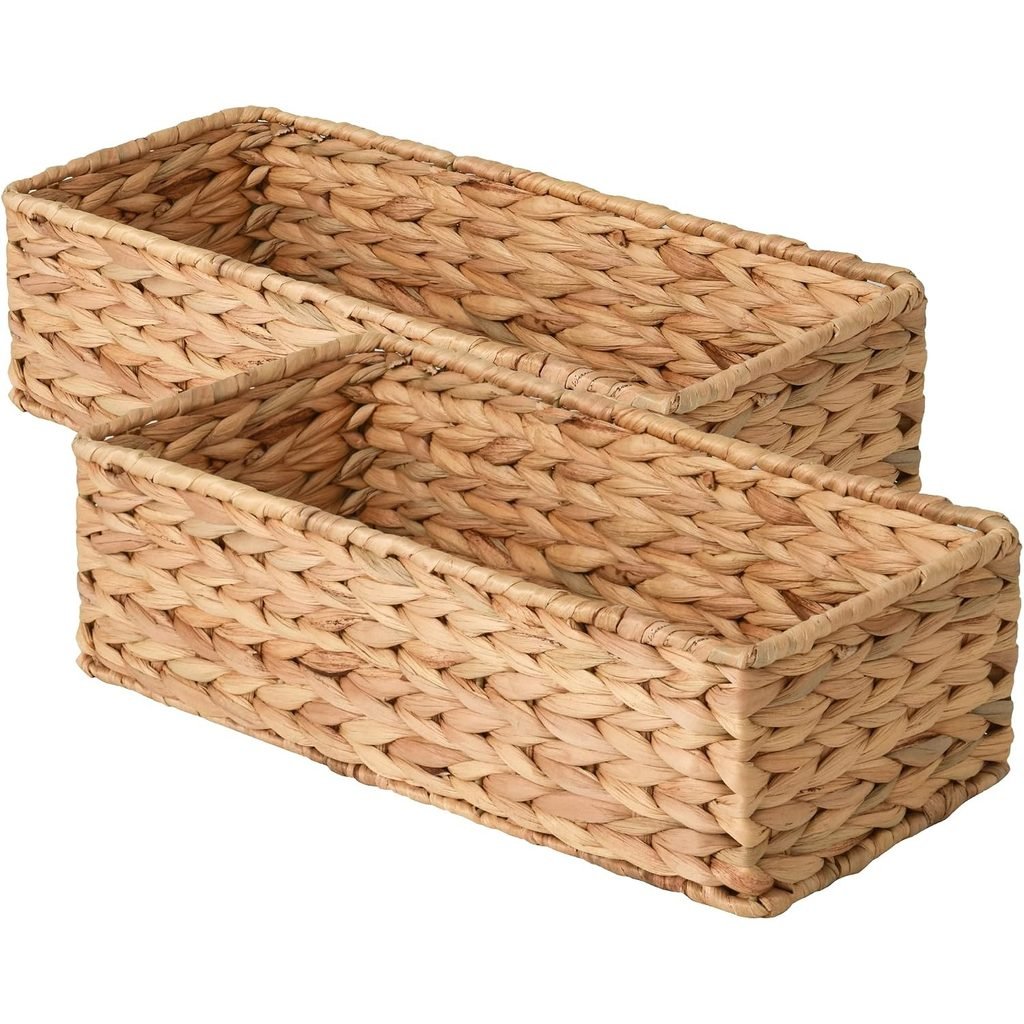
Adds natural texture and easy storage.
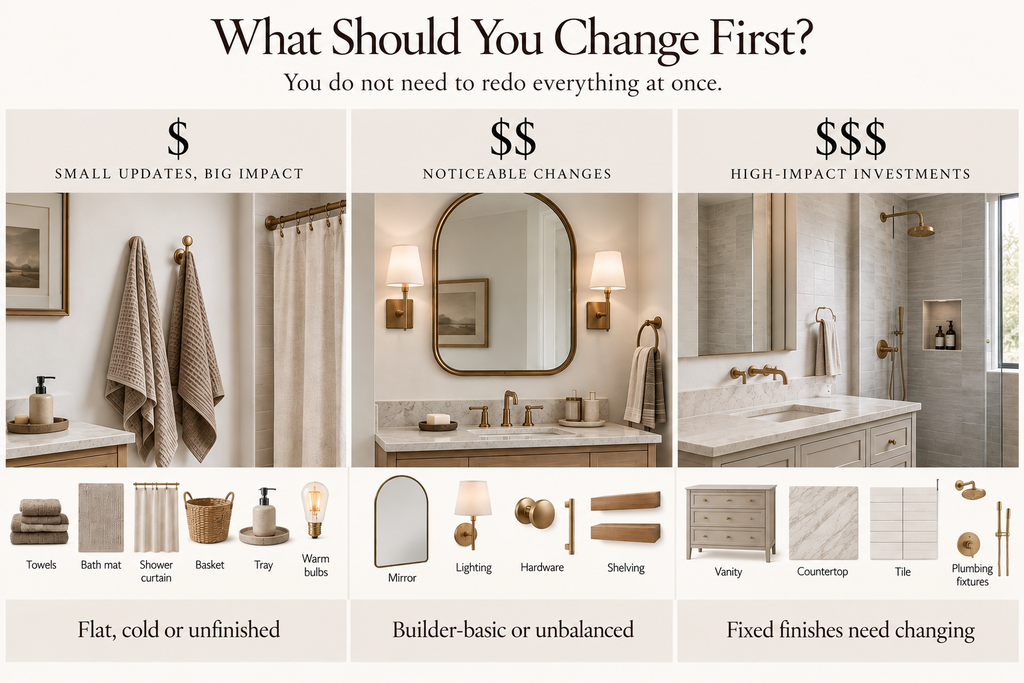
What Should You Change First? A $ / $$ / $$$ Guide
You do not need to redo everything at once.
Prioritize the changes that solve the actual weakness in the room.
| Budget | Start here | Best when the bathroom feels… |
|---|---|---|
| $ | Towels, bath mat, shower curtain, basket, tray, warm bulbs | Flat, cold or unfinished |
| $$ | Mirror, lighting, hardware, shelving | Builder-basic or visually unbalanced |
| $$$ | Vanity, countertop, tile, plumbing fixtures | The fixed finishes themselves are the problem |
With a Small Budget
Choose items with enough visual presence to matter.
A substantial bath mat or shower curtain usually changes the room more than three tiny accessories.
With a Moderate Budget
Look at the mirror and lighting.
Together, they define much of the vanity wall and can shift the room from builder-basic to intentional.
During a Renovation
Choose fixed finishes before decorating.
Make sure the:
- Tile
- Vanity
- Countertop
- Wood tone
- Plumbing finish
work together before buying the finishing pieces.
A beautiful accessory cannot correct a permanent finish you never liked in the first place.
Quick Fixes for White, Beige and Gray Bathrooms
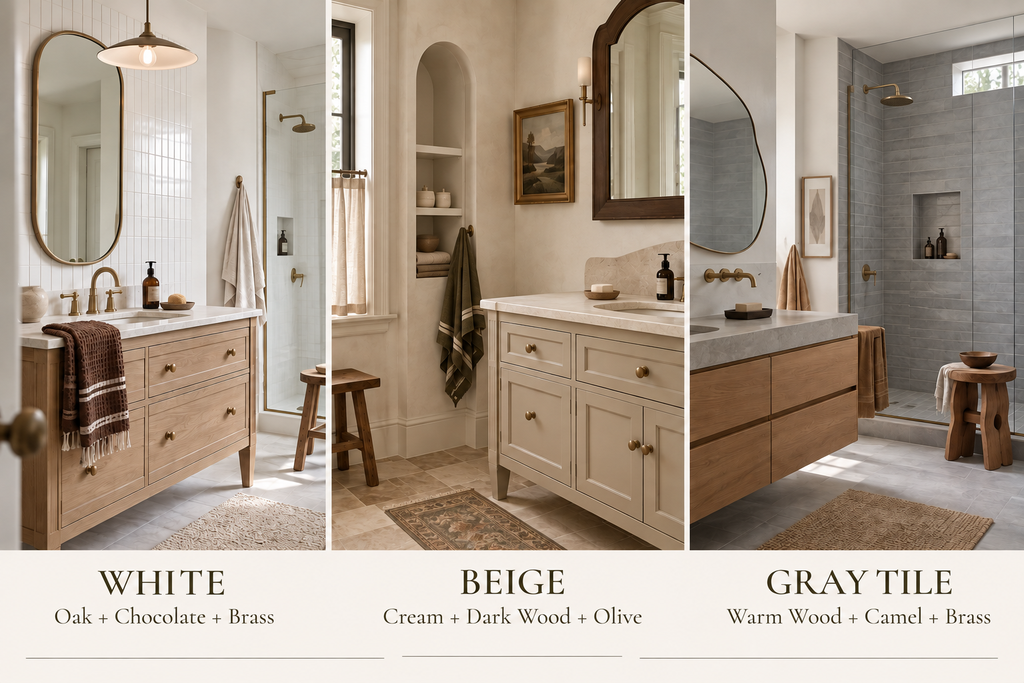
Different neutrals need different corrections.
If Your Bathroom Is Mostly White
A white bathroom usually needs material warmth, not another major color.
Try adding:
- Oak or walnut
- Cream or mushroom textiles
- Woven storage
- Textured towels
- Natural-looking stone or ceramic
- Softer balanced lighting
Keep the white.
Give it warmer materials to sit beside.
If Your Bathroom Is Beige
Do not assume the solution is another shade of beige.
Try introducing:
- Walnut
- Chocolate brown
- Bronze
- Muted olive
- Warm white
- Textured cream
The room will still feel neutral, but it will have clearer visual structure.
If Your Bathroom Has Gray Tile You Can’t Replace
Do not force extremely warm yellow-beige against cool gray.
Instead, create a bridge with colors such as:
- Mushroom
- Balanced taupe
- Warm white
- Medium wood
- Soft brown
- Carefully chosen cream
These middle tones can connect cooler permanent finishes to warmer materials without making the contrast feel accidental.
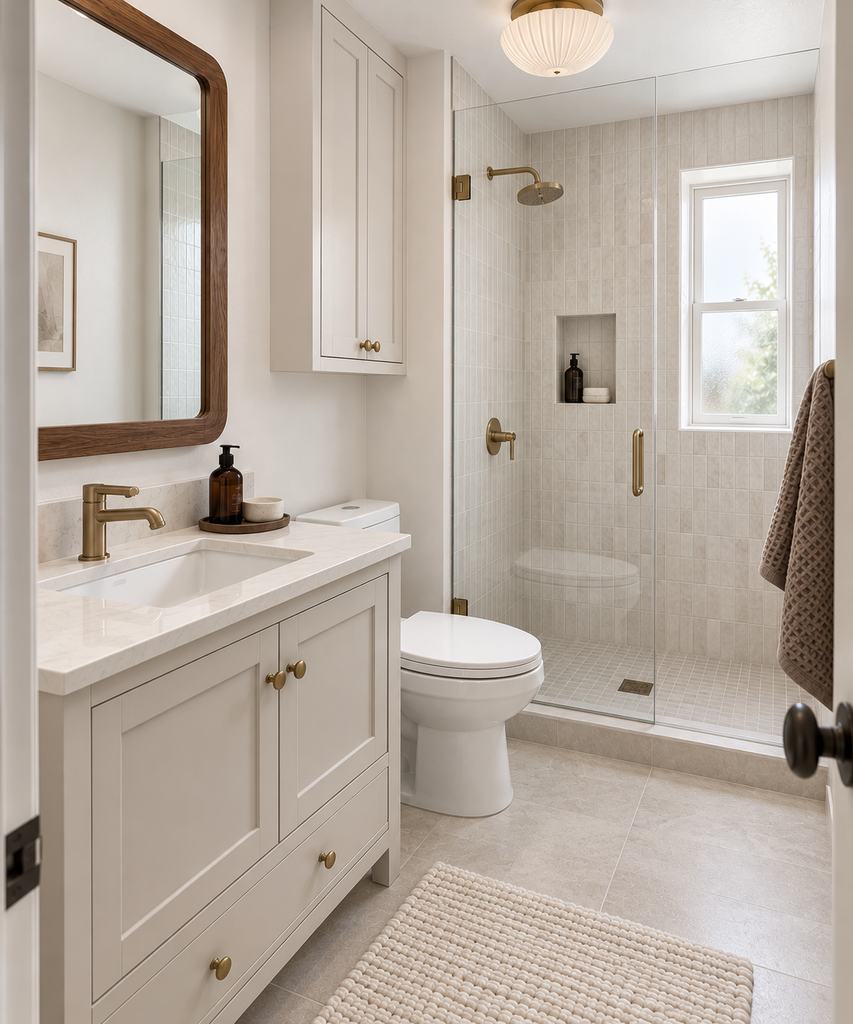
How to Make a Small Bathroom Feel Cozy Without Making It Dark
A small bathroom does not need to be pale from floor to ceiling.
It just needs contrast in controlled amounts.
Use:
- One wood tone
- One deeper accent
- Textured textiles
- Good lighting
- Closed or consolidated storage
- Fewer, better-scaled accessories
Let deeper tones ground the space rather than cover it.
For example:
warm white + walnut mirror + mushroom towels + textured ivory bath mat
has enough contrast to feel layered without turning a compact bathroom dark.
Also pay attention to clutter. In a small room, the visual effect of ten bottles or five tiny decor pieces is amplified.
If you want more warmth, add material and texture before adding more objects.
Warm Neutral Bathroom Checklist
Before buying another piece of bathroom decor, ask:
- Have I identified the finishes that are staying?
- Do those finishes lean warm, cool or balanced?
- Is the lighting making the room look colder?
- Does the room have one grounding material or deeper neutral?
- Is there enough contrast?
- Do I have at least two or three different textures?
- Am I adding beige because it helps—or simply because the room is neutral?
- Do the metal finishes feel intentional together?
- Are the bath mat, towels and shower curtain supporting the palette?
- Is clutter making the room feel less finished?
- Am I trying to fix a scale or lighting problem with small accessories?
You probably do not need to change everything.
A bathroom that feels cold may need better light. A bathroom that feels flat may need wood and texture. A beige bathroom may simply need contrast.
If you’re deciding how to make a neutral bathroom feel warm, start with the fixed finishes, identify the weakest layer, and correct that first.
The most convincing warm neutral bathrooms are not warm because every surface is beige—and they do not look expensive because every item is expensive. They work because light, material, contrast, texture and scale feel intentional together.
Ready to finish the space?
The same principles apply beyond the bathroom. If you’re working on another space, see my guide to 15 Warm Neutral Living Room Ideas for a Cozy, Layered Home.
Working on Your Living Room Next?
Get my free Neutral Living Room Checklist for the key pieces that make a neutral space feel warm, finished and pulled together.