

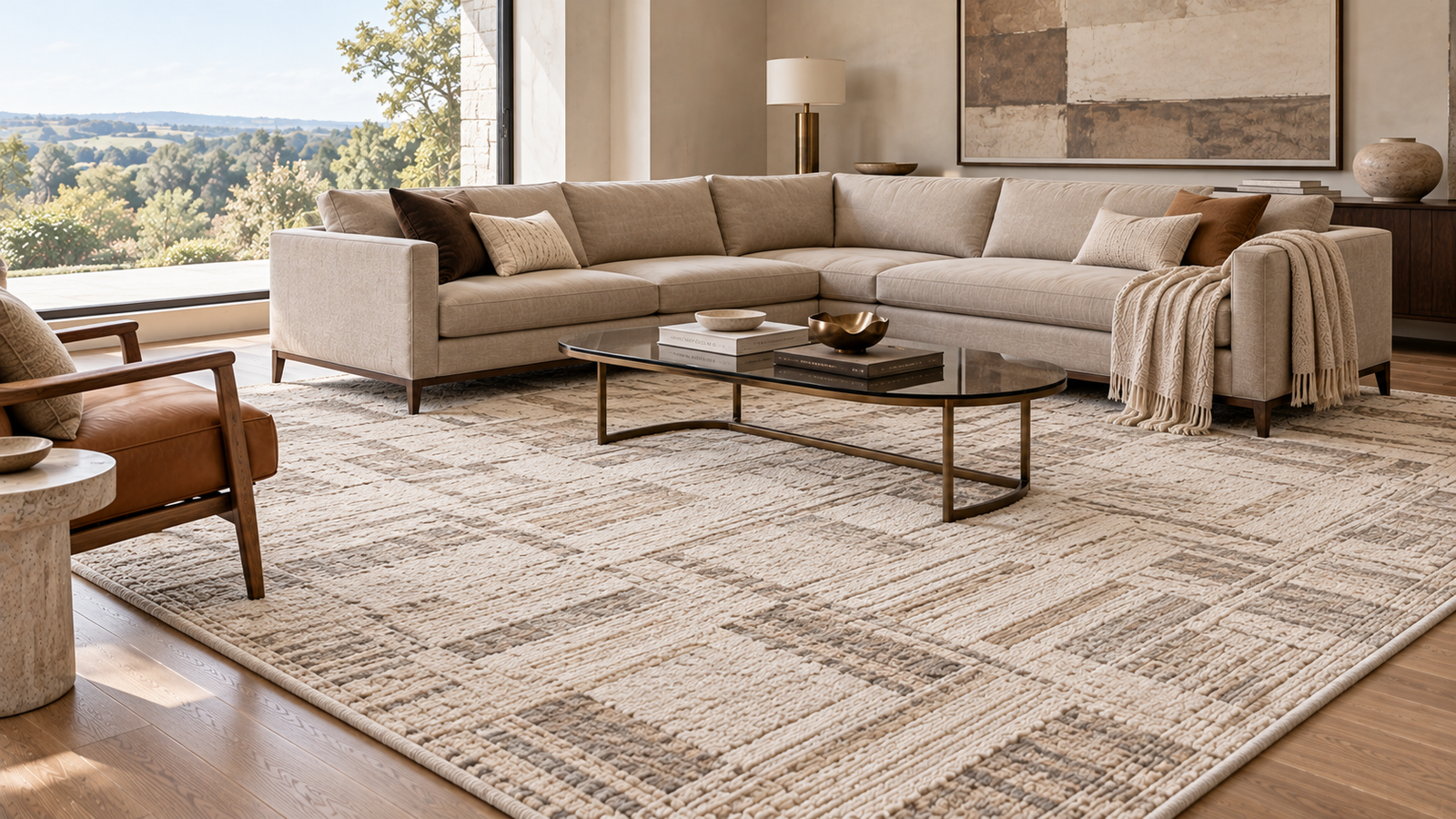
Choosing a rug for a sectional can be tricky. An 8×10 might look large enough until you place it beneath the sofa, while a 9×12 could overwhelm a smaller living room.
So, what size rug under a sectional works best? An 8×10 or 9×12 is a practical starting point for many layouts, but the right size depends on your sectional’s dimensions, how you want the furniture positioned, and the space around it.
Here’s how to compare sizes, measure your room, and choose a rug that fits without guessing.
This post contains affiliate links. I may earn a commission from qualifying purchases at no additional cost to you. As an Amazon Associate I earn from qualifying purchases.
What Size Rug Works Best Under a Sectional?
An 8×10 rug often works for a compact sectional with front-leg placement, while a 9×12 can provide better coverage for larger sectionals or seating arrangements that include an accent chair. Oversized sectionals may need a 10×14 or larger.
The best size connects the seating area without crowding the room.
| Rug Size | When to Consider It | What to Check |
|---|---|---|
| 8×10 | Compact sectionals or front-leg placement | Does it reach beneath both sides of the sectional? |
| 9×12 | Larger sectionals, deeper chaises, or seating groups with chairs | Does it provide enough coverage without crowding walkways? |
| 10×14 | Oversized sectionals in spacious rooms | Can the room accommodate the rug’s full footprint? |
These are guidelines, not fixed rules. A sectional with a deep chaise may require more rug coverage than a wider sofa with a shallower footprint.
Start with the sectional’s measurements, then decide how much furniture you want on the rug. That will narrow your choices more reliably than sofa size alone.
How Rug Size Changes With Your Sectional Layout
Different sectional configurations create different rug-placement challenges. The goal is to make the rug feel connected to the entire seating arrangement.
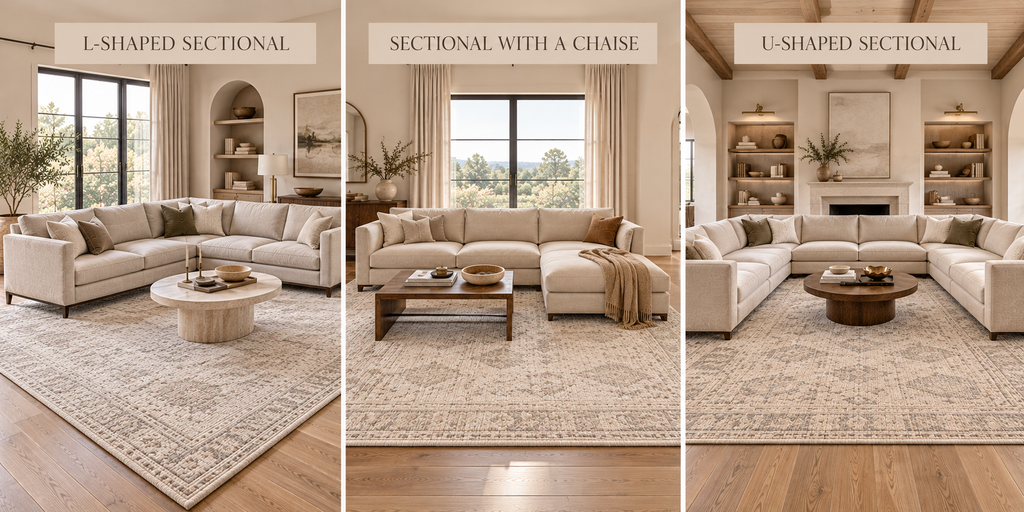
L-Shaped Sectionals
A true L-shaped sectional extends in two directions, so the rug needs to relate to both sides.
For front-leg placement, position the rug beneath the front feet along both arms of the sectional. An 8×10 may suit a smaller L-shaped sofa, while a substantial sectional may require a 9×12 or larger.
Before buying, try both orientations. Turning a rectangular rug can improve coverage without increasing its size.
Sectionals With a Chaise
A chaise extends farther into the room than standard seating, making rug depth especially important.
The chaise does not always need to sit completely on the rug. With front-leg placement, the rug can extend beneath the front of the main sofa while visually connecting the chaise to the seating area.
However, check where the chaise’s supporting feet actually sit. If you want every leg on the rug, measure the full chaise projection and choose a rug deep enough to accommodate it.
A 9×12 may offer more flexibility than an 8×10 for a deep chaise, but the room’s available floor space still determines whether it’s appropriate.
U-Shaped Sectionals
A U-shaped sectional surrounds the center of the seating area on three sides. A small rug placed only beneath the coffee table can look disconnected from the surrounding furniture.
For a substantial U-shaped sectional, a 9×12 or 10×14 may be a useful starting point.
Aim to position the rug so it connects the front of the seating sections rather than appearing isolated in the middle. Check the width between the opposing arms and the depth of the arrangement before deciding.
For more help arranging your furniture, see our Sectional Sofa Layout Ideas for Better Flow, Balance, and Comfort guide.
8×10 vs. 9×12: Which Rug Size Should You Choose?
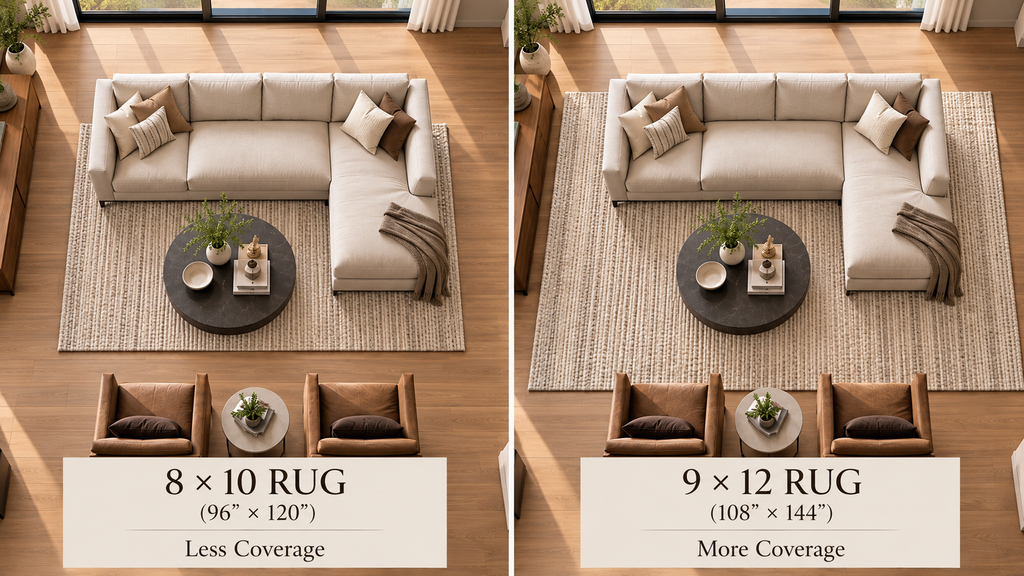
The difference between an 8×10 and a 9×12 is more noticeable than it sounds.
An 8×10 measures 96 × 120 inches, while a 9×12 measures 108 × 144 inches. The larger rug provides an additional foot in one direction and two feet in the other.
An 8×10 may be enough if:
- Your sectional is relatively compact.
- You want only the front legs on the rug.
- A larger rug would interfere with nearby walkways.
A 9×12 may work better if:
- Your sectional has a wide or deep footprint.
- You prefer more of the furniture resting on the rug.
- You want to include an accent chair in the same seating group.
Consider a sectional that’s 110 inches wide. With the rug’s longer side running parallel to the sofa, an 8×10 provides approximately 5 inches beyond each end when centered. A 9×12 provides approximately 17 inches per end.
That makes the 9×12 more generous across the sofa’s width, but it doesn’t automatically make it the better choice. You still need to check the rug’s depth, the chaise position, and the available room clearance.
If both sizes fit, choose based on the furniture you want the rug to connect—not simply which rug covers more floor.
Once you know which dimensions work, explore our Best Neutral Area Rugs for Living Rooms guide for rug options in different styles and materials.
Should Your Sectional’s Front Legs or All Legs Sit on the Rug?
Both placement methods can look intentional. The difference is how much of the furniture the rug needs to support.
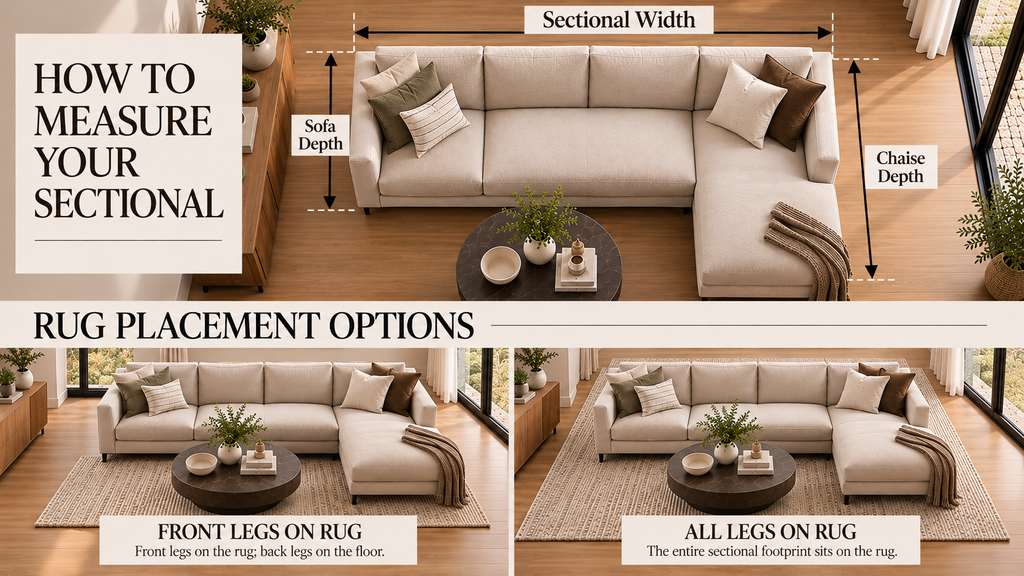
Front legs on the rug: A practical choice for many living rooms. Position the rug beneath the front feet of the sectional so it visually anchors the seating area while the back legs remain on the floor.
All legs on the rug: Better suited to arrangements with enough space for a larger rug. This creates a more complete furniture grouping but requires coverage beneath the sectional’s full footprint.
Neither approach is automatically better.
If your arrangement includes an accent chair, placing its front legs on the same rug can help connect it to the sectional.
For sectionals with a chaise, confirm that the chosen placement works with the chaise’s actual supporting feet rather than relying on the appearance of the cushions alone.
How to Measure for a Rug Under a Sectional
The easiest way to avoid buying the wrong size is to outline the rug on your floor before ordering.
- Measure the full sectional width. Include both ends of the sofa, not just the seating cushions.
- Measure the deepest section. Include the full projection of a chaise or L-shaped return.
- Decide on leg placement. Will the rug sit beneath the front legs or the entire sectional?
- Test both rug orientations. An 8×10 offers 96 inches in one direction and 120 inches in the other; a 9×12 offers 108 and 144 inches.
- Mark the rug’s corners with painter’s tape. Use the actual dimensions of the rug you’re considering, then check how the outline relates to the sofa, coffee table, accent chairs, and walkways.
For example, a 110-inch-wide sectional centered along the 120-inch side of an 8×10 leaves only 5 inches of rug beyond each end. If you want a more generous extension, the 144-inch side of a 9×12 gives you 17 inches per end.
But width is only half the decision. Check how far the rug reaches beneath the sectional and whether its opposite edge leaves comfortable space for the coffee table and circulation.
For a small living room, prioritize usable floor space over maximizing rug coverage. A properly positioned 8×10 can be a better choice than a 9×12 that crowds the room.
Common Rug Placement Mistakes—and How to Fix Them
Choosing a rug that’s too small. If it sits entirely beneath the coffee table without connecting to the sectional, the furniture can feel visually separated. Try moving the rug farther beneath the sofa before deciding to replace it.
Ignoring orientation. A rectangular rug may fit better when rotated 90 degrees. Test both directions before shopping for a larger size.
Assuming bigger is always better. A rug should define the seating area, not create awkward edges across walkways or interfere with doors.
Forgetting the chaise. Measuring only the sofa’s width can leave you with a rug that doesn’t work with the chaise’s deeper footprint.
Replacing a rug that could be repositioned. If your current rug is close to the right size, center it beneath the seating arrangement and adjust how far it extends under the front legs.
Sometimes a few inches of repositioning make more difference than purchasing an entirely new rug.
Ready to Choose a Neutral Area Rug?
Once you’ve confirmed the dimensions, consider the rug’s texture, construction, and cleaning requirements.
For a cream or beige sectional, an oatmeal, ivory, or soft taupe rug can create a cohesive foundation. A subtle pattern or textured weave adds interest without competing with the furniture.
Check each product’s actual dimensions rather than relying solely on its advertised size category. Also review pile height, cleaning instructions, and whether the rug requires a pad.
Browse our Best Neutral Area Rugs for Living Rooms guide to compare options for different spaces and budgets.
The right rug should connect your sectional and surrounding furniture while leaving the room comfortable to move through. Measure first, test the placement, and choose the size that works for your actual layout.
Looking for more neutral home finds?
Browse my Amazon Storefront for curated home décor favorites, including pieces that pair beautifully with sectional sofas. From textured rugs to coffee tables and finishing touches, it’s an easy place to explore ideas for your living room.
Creating a Cozy, Balanced Living Room?
Choosing the right rug is just one part of bringing a room together. Get my free Neutral Living Room Checklist for simple ideas to help you coordinate furniture, colors, textures, and finishing touches.
[…] For more guidance, explore The Best Neutral Area Rugs for Living Rooms and What Size Rug Goes Under a Sectional? […]