


Curtains can completely change how a room looks, but even beautiful fabric can feel awkward when the proportions are wrong.
Sometimes the problem isn’t the curtains themselves. It’s that the rods are mounted too low, the panels don’t have enough fullness, or the fabric stops too far above the floor.
The good news? Many curtain hanging mistakes can be corrected without replacing everything.
Learning how to hang curtains correctly starts with three important measurements: rod height, rod width, and curtain length. Once you understand how these work together, you can avoid common buying mistakes and create windows that look taller, wider, and more balanced.
This post contains affiliate links. I may earn a commission from qualifying purchases at no additional cost to you. As an Amazon Associate I earn from qualifying purchases.
How High, Wide, and Long Should Curtains Be?
For most living rooms and bedrooms, start by positioning the curtain rod above the window trim, extending it beyond both sides, and choosing panels that reach close to the floor.
These measurements are useful starting points:
| What to Measure | Starting Point |
|---|---|
| Rod height | Approximately 4–6 inches above the window trim |
| Rod extension | Approximately 6–12 inches beyond each side |
| Curtain fullness | Around 2 times the usable rod span for many unpleated panels |
| Curtain length | Lightly touching the floor or floating about ½ inch above it |
The right measurements depend on the available wall space, window proportions, curtain header, and hanging hardware.
A rod that’s positioned perfectly for one window may look awkward on another. Use these guidelines to plan your arrangement, then measure the actual space before ordering.
If you’re decorating an entire living room, my guide to 15 Warm Neutral Living Room Ideas for a Cozy, Layered Home explains how curtains work alongside rugs, furniture, and other textiles to create a more finished space.
Mistake #1: Hanging Curtain Rods Too Low
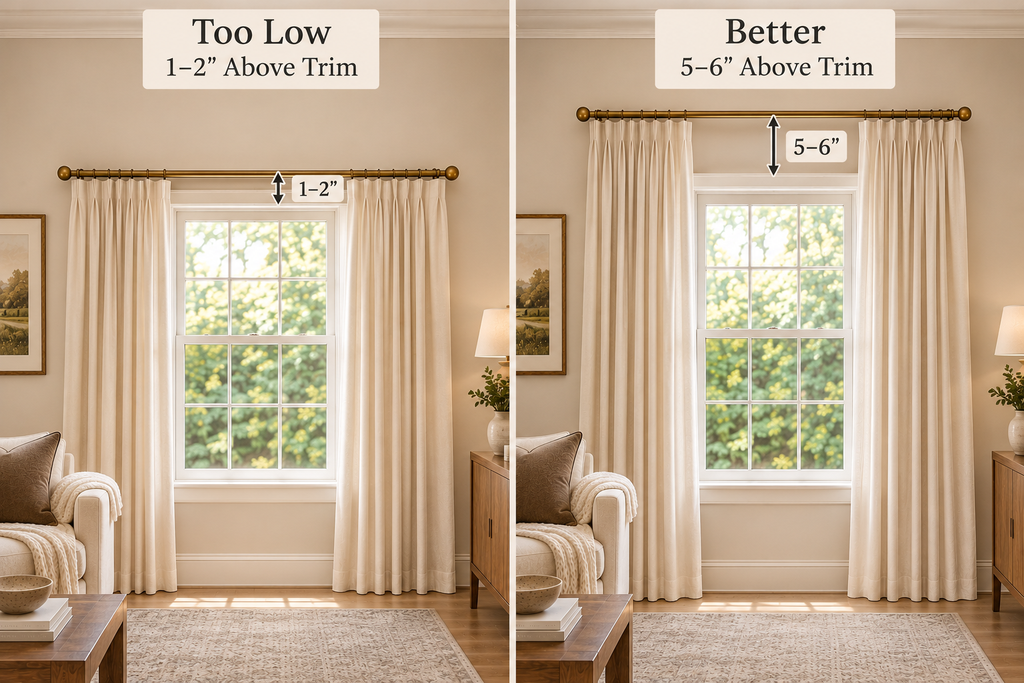
When a curtain rod sits directly above the window frame, it emphasizes the window’s existing height. The curtains can look compressed, particularly in rooms with standard-height ceilings.
Raising the rod creates a longer vertical line, helping the window appear taller.
How High Above the Window Should Curtains Hang?
A practical starting point is 4–6 inches above the top of the window trim.
If there’s plenty of wall space between the trim and ceiling, you can consider hanging the rod higher. If the window sits close to the ceiling, use the available space without crowding the molding.
For example, imagine an 8-foot ceiling with 12 inches between the window trim and ceiling. Placing the rod about 5–6 inches above the trim can create a balanced look while leaving visible wall space above it.
But don’t choose the height without considering curtain length. Raising the rod also increases the distance the fabric must travel to reach the floor.
A useful design rule: Choose the rod height and curtain length together. A higher rod won’t improve the room if the curtains end several inches above the floor.
Mistake #2: Using a Curtain Rod That’s Too Narrow
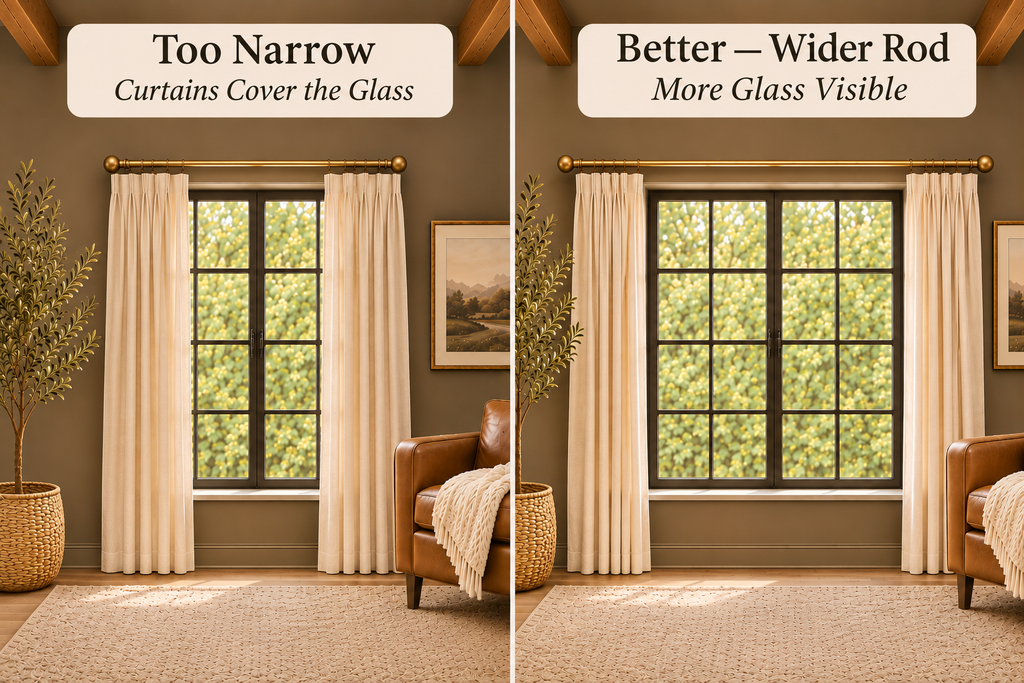
A curtain rod that’s only slightly wider than the window leaves little room for the fabric when the curtains are open.
Instead of resting against the wall, the panels cover part of the glass. That reduces natural light and can make the window look narrower.
How Far Should a Curtain Rod Extend Past the Window?
For many windows, extending the rod 6–12 inches beyond each side is a reasonable starting point.
The ideal extension depends on the amount of fabric, the curtain header, and the available wall space.
Consider a window measuring 60 inches wide.
If you extend the rod 8 inches beyond each side:
60 + 8 + 8 = 76 inches
You’ll need approximately 76 inches of usable rod span.
Decorative finials may add to the overall length without increasing the space available for the curtains.
Before buying a rod, check whether:
- There’s enough wall space for the extension.
- Open curtains can stack without covering too much glass.
- Nearby furniture or doors limit placement.
- The rod requires additional support for its span and curtain weight.
A simple aged-brass or dark bronze rod can add subtle definition to ivory or oatmeal curtains without competing with the rest of the room.
If your existing rod is too narrow, replacing it with a properly sized adjustable rod may make more sense than purchasing new curtains.
Style Pick: An Adjustable Curtain Rod
An adjustable curtain rod is one of the simplest upgrades when existing curtains cover too much of the window. I especially like understated aged-brass or bronze finishes for warm-neutral rooms because they add definition without looking overly decorative.
Look for a rod with the correct usable span, a suitable diameter, and brackets that support your curtain weight.

Mistake #3: Buying Curtain Panels That Aren’t Full Enough
Curtains can reach the floor and still look disappointing if there isn’t enough fabric across the window.
When panels are too narrow, they hang almost flat when closed instead of forming soft, natural folds.
This is especially noticeable with lightweight curtains and simple rod-pocket or back-tab styles.
How Wide Should Curtain Panels Be?
For many unpleated curtains, plan for a combined flat fabric width of approximately 1.5–2.5 times the usable rod span.
Around 2 times fullness is a helpful starting point for a balanced, gathered appearance.
Here’s an example for a 60-inch window:
| Measurement | Example |
|---|---|
| Window width | 60 inches |
| Rod extension | 8 inches on each side |
| Usable rod span | 76 inches |
| Fullness target | 2 times |
| Combined flat panel width | 152 inches |
Now consider standard panels that are each 50 inches wide.
Two panels provide 100 inches of combined flat width. On a 76-inch rod, that produces relatively little fullness when the curtains are closed.
Four panels provide 200 inches of combined flat width, or approximately 2.6 times fullness on a 76-inch rod. This creates a more gathered appearance than two panels, although the finished look will depend on the fabric and curtain header.
Neither option is automatically right. The best choice depends on the fabric, header, desired appearance, and whether the panels need to close completely.
Flat Width vs. Finished Pleated Width
This distinction is important when shopping.
Flat panel width describes the fabric’s width before it is gathered or pleated.
Finished pleated width may describe the actual coverage after permanent pleats have been sewn into the panel.
Some pinch-pleat curtain manufacturers already account for fullness in their finished-width specifications. Multiplying that width by two again could lead to buying far more fabric than necessary.
Always read the manufacturer’s measuring instructions.
Before purchasing, check whether the listed price includes one panel or a pair. Also compare the total width included in the package, not just the width shown in the product title.
For a warm, relaxed living room, textured ivory or flax-colored panels with generous folds can look more substantial than thin panels stretched tightly across the rod.
Style Pick: Textured Ivory or Oatmeal Curtain Panels
For an elevated neutral look, I would choose full-length panels with a soft woven texture rather than a shiny or completely flat finish.
Warm ivory is beautiful against cream or light beige walls, while oatmeal and flax offer a little more contrast. The right choice depends on your existing wall color, sofa, and flooring.
Choose panels with enough combined width to create natural folds, and verify the fabric composition, length, and number of panels included.

If you’re trying to coordinate curtains with a cream sofa, explore What Colors Go With a Cream Sofa? for ideas on combining warm neutrals, wood tones, and deeper accents throughout the room.
Mistake #4: Choosing the Wrong Curtain Length
Curtains that stop several inches above the floor can make a room look unfinished when the gap wasn’t intentional.
Excessively long curtains can create the opposite problem, with fabric bunching across the floor and getting caught when the panels move.
The right finish depends on the room’s style and how the curtains will be used.
Should Curtains Touch the Floor?
There are four common curtain finishes:
| Finish | How It Looks | Practical Consideration |
|---|---|---|
| Floating | Fabric stops slightly above the floor | Easy to open, close, and clean around |
| Just touching | Hem lightly meets the floor | Clean, tailored appearance |
| Slight break | A little fabric rests on the floor | Softer, more relaxed look |
| Puddling | Extra fabric gathers on the floor | More decorative, less practical |
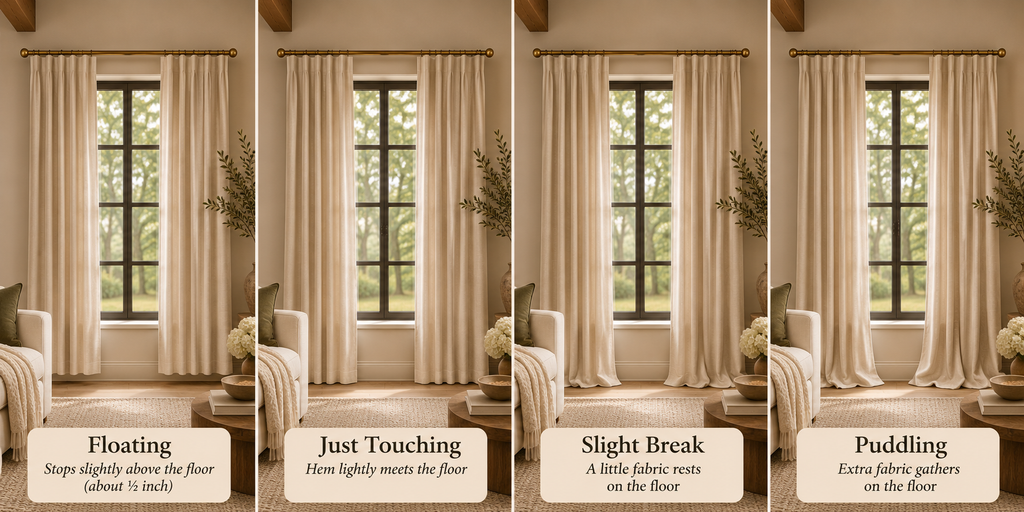
For most everyday living rooms, I prefer curtains that lightly touch the floor or float approximately ½ inch above it.
They create a finished appearance without excess fabric collecting on the floor.
A slight break can work beautifully with soft linen or linen-look fabric, especially in a relaxed bedroom. Puddling is better reserved for spaces where the curtains are primarily decorative and aren’t moved frequently.
Are 84-Inch Curtains Long Enough for 8-Foot Ceilings?
They can be, but an 8-foot ceiling doesn’t automatically mean you need 84-inch curtains.
An 8-foot ceiling measures 96 inches from floor to ceiling. What matters is the distance from the curtain’s actual hanging point to the floor.
For example:
- If the fabric hangs from a point 85 inches above the floor, an 84-inch panel may finish approximately 1 inch above it.
- If the fabric hangs from a point 93 inches above the floor, the same panel would finish approximately 9 inches above it.
These examples assume the stated panel length is measured from the relevant hanging point. Rings, hooks, and curtain headers can change the result.
That’s why choosing between 84-, 96-, and 108-inch curtains based on ceiling height alone can lead to mistakes.
Measure first, then choose the closest suitable length. If a standard panel is slightly too long, hemming may produce a better result than moving the rod to an awkward height.
Mistake #5: Forgetting That Curtain Hardware Changes the Fit
Curtain panels don’t all hang from the same point on the rod.
Grommet curtains slide directly onto it. Back-tab curtains hang from fabric loops behind the panel. Rings and hooks introduce separate attachment points.
Those differences affect the final curtain length and the way the fabric falls.
How Do You Measure Curtains With Rings or Hooks?
Start by identifying exactly where the fabric will be supported.
For clip rings, measure from the point where the clip grips the fabric to the desired hem position.
For drapery hooks, follow the manufacturer’s instructions for hook placement and the curtain header. Some pleated panels are designed to extend above the hook attachment point.
For grommet or back-tab curtains, account for how the top of the panel sits relative to the rod.
The important measurement is the finished fabric drop, not simply the distance from the top of the rod to the floor.
Before ordering hardware, verify:
- Curtain header compatibility.
- Ring or hook dimensions.
- Rod diameter.
- Panel weight.
- Whether the hardware changes the finished length.
Pinch-pleat curtains on coordinating rings create a more structured appearance, while back-tab curtains often feel simpler and more relaxed.
Neither is universally better. Choose the header based on the look you want and how often you’ll open the curtains.
Style Pick: Bronze Curtain Rings With Clips
If your curtain panels are compatible with clip rings, bronze curtain rings can provide an easy way to hang them while adding a coordinated finishing touch.
I like simple bronze hardware paired with warm ivory curtains. Keeping the finish consistent with the rod helps the arrangement feel intentional.
Before purchasing, verify the ring’s inside diameter, the rod diameter, and whether your curtain fabric and header are suitable for clips.

Mistake #6: Choosing Curtains That Don’t Suit the Room
Even perfectly measured curtains can look out of place when the fabric doesn’t complement the room.
Stiff fabric may create rigid folds. Very lightweight panels can look insubstantial without enough fullness. A cool, bright white may feel stark beside warm cream walls and natural oak furniture.
For a cozy neutral living room, consider:
- Warm ivory, oatmeal, or flax-colored fabric.
- Subtle woven texture rather than a flat, shiny finish.
- Aged-brass, bronze, or dark metal hardware.
- Enough fullness for relaxed vertical folds.
- Lining appropriate for the room’s privacy and light-control needs.
For example, oatmeal linen-look curtains paired with cream walls, a walnut coffee table, and a muted olive accent chair can add softness without making the room feel overly beige.
If the walls and curtains are similar in color, vary their texture or undertone slightly to create definition.
Remember that linen-look doesn’t necessarily mean linen. Many affordable textured curtains are made from polyester or fabric blends. Check the actual composition before buying.
Likewise, don’t assume a thick-looking curtain provides blackout performance. Verify the manufacturer’s light-blocking specifications and lining details.
If your living room already feels too cool, my guide to How to Warm Up Gray Floors explains how curtains, rugs, wood furniture, and warm textiles can work together to soften the entire space.
For a bedroom, you can also explore 15 Cozy Neutral Bedroom Ideas for ways to use curtains alongside bedding, lighting, and natural materials.
How to Measure for Curtains Before You Buy
Before ordering panels or hardware, work through these five measurements in order.
1. Measure the Window
Measure the full width, including the trim if you’re planning an outside mount.
Record the available wall space on both sides and the distance from the top of the trim to the ceiling.
2. Choose the Rod Position
Decide how high the rod should sit and how far it can extend beyond the window.
Make sure the position works with nearby furniture, doors, and architectural details.
3. Calculate the Usable Rod Span
Add the planned extension on both sides to the window width.
For a 60-inch window with 8 inches on each side, the usable span is approximately 76 inches.
Check that the selected rod can accommodate that span and the curtain weight.
4. Determine Panel Width and Quantity
For unpleated panels, multiply the rod span by your preferred fullness.
76-inch rod span × 2 = 152 inches of combined flat panel width
Then divide by the usable flat width of each panel to estimate the number needed, rounding up to a practical panel quantity.
For finished pinch-pleat curtains, use the manufacturer’s finished-width instructions instead.
5. Measure the Finished Length
Decide where the hem should end.
Measure from the actual fabric attachment point to that position, accounting for the curtain header and hardware.
Check the distance at several points if the floor isn’t level.
Before you order, confirm: panel quantity, usable width, length, header style, fabric composition, lining, care instructions, and rod compatibility.
A beautiful product photo can’t tell you whether the curtains will fit your particular window.
How to Fix Curtains That Are Too Short, Narrow, or Uneven
If your curtains are already installed, identify the problem before spending money on replacements.
| Problem | First Correction to Consider |
|---|---|
| Curtains are slightly too short | Check whether the rod can be lowered or compatible hardware can change the drop |
| Curtains are too long | Hem them or adjust the hanging position |
| Curtains look too narrow | Add matching panels if available |
| Curtains cover too much glass when open | Extend the rod farther if space allows |
| Curtains hang unevenly | Check bracket level, hooks, panel lengths, and floor measurements |
| Curtains look flat | Recalculate fullness and check the header style |
A small length problem may be fixable with a hardware adjustment. But if the curtains are several inches too short, replacing them may be more practical than compromising the rod height.
For overly long curtains, hemming is often the cleanest solution. Hem tape can be useful for compatible fabrics, although care requirements and fabric weight matter.
If the rod itself is too short, replacing the hardware may solve the problem while allowing you to keep the panels.
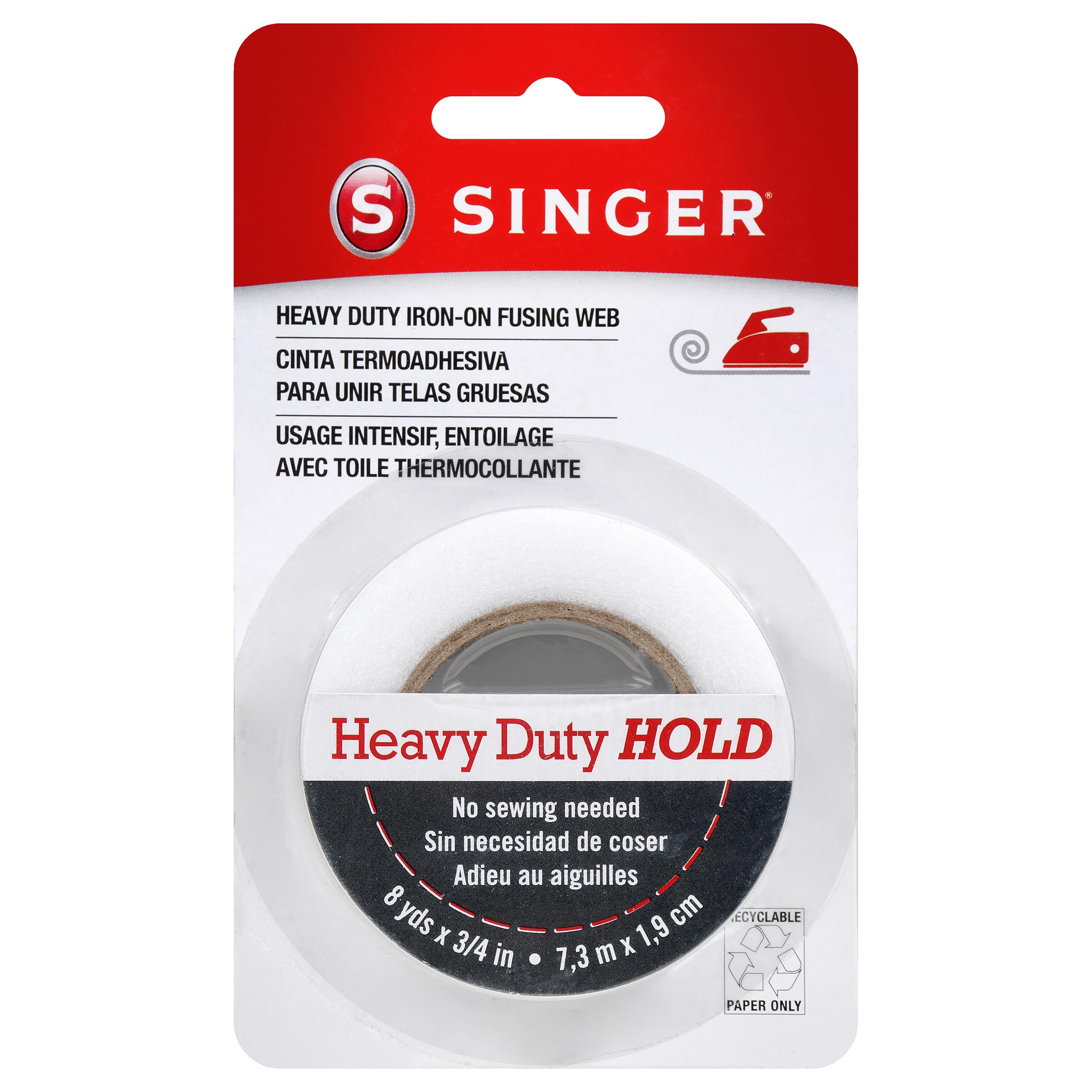
Helpful Find: Iron-On Hemming Tape
If your curtains are slightly too long, hemming tape may be an affordable alternative to replacing them or paying for alterations.
Choose a tape compatible with the curtain fabric, follow the manufacturer’s heat instructions, and test a hidden area first. Delicate or heat-sensitive fabrics may require a different hemming method.
Choose the smallest correction that actually fixes the proportions. New curtains aren’t always necessary.
Curtain Hanging FAQs
Can You Hang Curtains High and Wide With Very Little Wall Space?
Yes, within the space available. A window near a corner may need less rod extension on one side. Focus on balanced placement and usable curtain coverage rather than forcing a standard measurement.
Do Wide Windows Need a Center Support Bracket?
Many do, especially with longer rods or heavier curtains. Follow the rod manufacturer’s supported-span, weight, and bracket-placement instructions.
If you plan to open and close your curtains regularly, also check whether the curtain rings or panels can move past a center support bracket. Some rods require special bypass rings or brackets to allow curtains to travel across the full width.
Can Curtains Hang in Front of a Radiator or Baseboard Heater?
Only if the installation meets the heater manufacturer’s safety and clearance requirements. Fabric must not obstruct the heater or create a fire risk. A shorter treatment may be necessary.
Do All Rooms Need Floor-Length Curtains?
No. Floor-length curtains often suit living rooms and bedrooms, but shorter treatments can be more practical near counters, certain heating systems, or furniture that interferes with the fabric.
Should Curtains Match the Wall Color?
Not necessarily. Curtains close to the wall color create a softer, more continuous look, while slightly deeper shades add contrast.
For example, warm ivory curtains can blend beautifully with cream walls, while oatmeal or mushroom-colored panels may create more depth.
Texture matters just as much as color. A woven curtain can stand out subtly even when the fabric and wall are similar shades.
Make the Measurements Work Together
The most important curtain measurements are where the rod sits, how wide the panels are, and where the fabric ends.
Before replacing curtains that look wrong, check those three things first. A small adjustment in placement, fuller panels, or a simple hem may be all the window needs.
And when you’re shopping for new curtains, measure the finished arrangement—not just the window. That’s what turns a beautiful fabric into curtains that actually look right in your room.
For more ways to bring warmth and balance into your space, explore 15 Warm Neutral Living Room Ideas for a Cozy, Layered Home on Nicole Home Finds.
Want Your Entire Living Room to Feel More Put Together?
Hanging curtains correctly is just one way to make your living room feel more polished and inviting. The right furniture placement, textures, colors, and finishing touches can make just as much of a difference.
Download my FREE Neutral Living Room Checklist for simple decorating tips to help you create a warm, cozy, beautifully balanced space.